
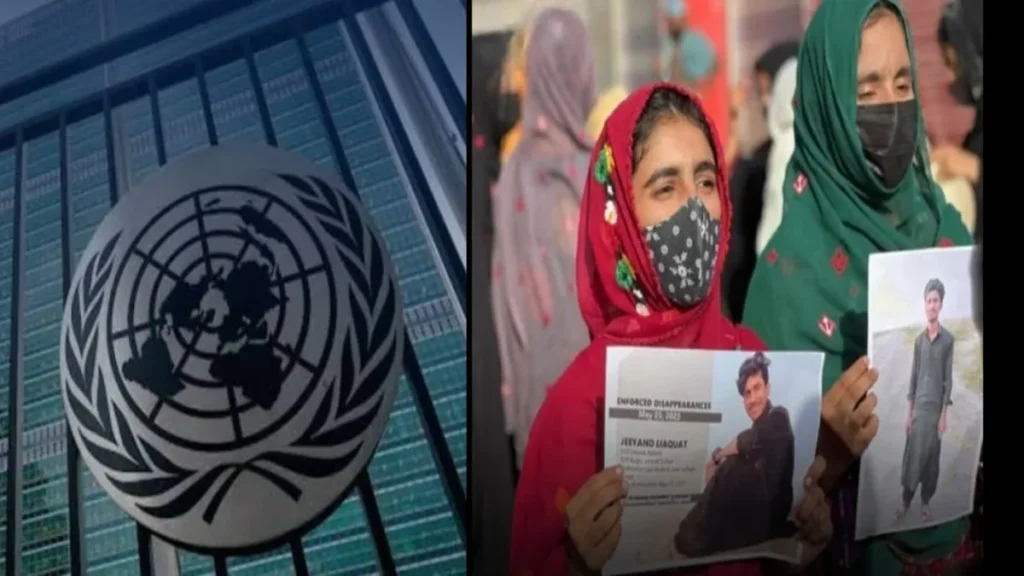
Balochistan Under UN Lens: Experts raise alarm over alleged disappearances, torture and killings
Author: Sant Kumar Sharma
Date: September 11, 2026
Source: Organiser (International Edition / World News)
Human rights experts of the United Nations (UN) have expressed grave concern over alleged continued enforced disappearances, torture, and extrajudicial killings in the Balochistan region of Pakistan by security forces. They specifically highlighted the killing of a Baloch student, Imran Ali, calling on Pakistan to conduct a prompt, independent, and impartial investigation into the circumstances surrounding his detention and death.
The statement was issued by members of the UN Working Group on Enforced or Involuntary Disappearances—including Gabriella Citroni (Chair-Rapporteur), Grażyna Baranowska (Vice-Chair), Aua Baldé, Ana Lorena Delgadillo Pérez, and Mohammed Al-Obaidi. The statement was also endorsed by Morris Tidball-Binz (UN Special Rapporteur on extrajudicial, summary or arbitrary executions), Nicolas Levrat (Special Rapporteur on minority issues), and Ben Saul (Special Rapporteur on the promotion and protection of human rights and fundamental freedoms while countering terrorism).
Imran Ali’s Enforced Disappearance, Torture & Death
According to the UN experts, Imran Ali was allegedly detained by personnel of Pakistan’s Counter-Terrorism Department (CTD) on August 27 of last year and taken to an undisclosed location. His family received no official information regarding his whereabouts for nearly a year, although individuals who were previously detained alongside him later confirmed that he had been held in custody and subjected to torture.
Referring to international legal standards, the experts noted that any deprivation of liberty followed by a refusal by authorities to acknowledge the detention or disclose a person’s fate or whereabouts constitutes an enforced disappearance, placing the individual outside the protection of the law.
The family reportedly learned of Ali’s death during a hearing before Pakistan’s Commission of Inquiry on Enforced Disappearances on August 6 this year, when a police officer informed the commission that Ali had been killed in an encounter in May 2026. Authorities reportedly took about a month to identify the body and subsequently buried it in June 2026, citing an inability to preserve the remains. Following this disclosure, Ali’s family visited the Civil Hospital in Quetta and identified his body through photographs kept on record.
Unidentified Bodies and Broader Pattern Concerns
The UN statement highlighted that Ali’s body had reportedly been brought to the Quetta hospital alongside six other unidentified bodies. None of these six bodies were documented or reported by hospital staff or police before they were buried without proper identification or notification to their families.
The experts expressed concern that given the broader context in the region, the unidentified remains could belong to other victims of enforced disappearances. They urged Pakistani authorities to carry out thorough investigations—including independent forensic examinations, proper identification, and the dignified return of remains to families.
The experts warned that Ali’s case reflects a broader pattern of alleged unlawful detentions, torture, enforced disappearances, and extrajudicial killings of Baloch individuals, occurring amid intensified military and security operations in the region. The UN experts noted that they remain in contact with the Government of Pakistan regarding these human rights concerns.