
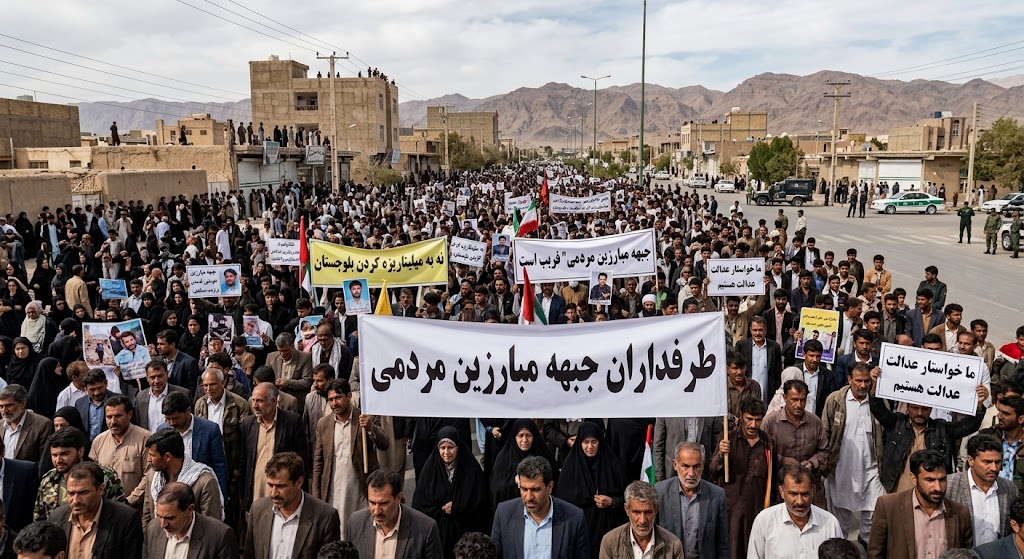
Claim of 50,000 Members in the “Popular Fighters’ Front”: Is the Islamic Republic Paving the Way for Intensified Crackdowns in Sistan and Baluchestan?
According to a report by Baloch Media on Saturday, October 10, 2026, the state-run outlet NourNews—affiliated with the Supreme National Security Council—claimed that 50,000 individuals have been organized into groups known as the “Popular Fighters’ Front” and that 1,500 of them have been deployed into Iran. These claims, made without providing verifiable evidence, raise concerns that the government might be using this security narrative to justify intensifying pressure and repression against the Baloch people.
NourNews announced the alleged organization of 50,000 individuals into the “Popular Fighters’ Front” following the killing of Colonel Nosrat Eftekhari Poudineh—the Deputy for Cultural and Social Affairs of the Sistan and Baluchestan Law Enforcement Command—during recent security incidents. The outlet further claimed that approximately 1,500 members of these groups had been deployed into Iran and alleged that certain Persian Gulf Arab states play a role in providing financial, intelligence, and military support to armed groups active in the region.
Despite the significant scope of these claims, NourNews has not published verifiable evidence regarding the source of the 50,000-person figure, the criteria used to identify members, the logistics of the 1,500-person deployment, or proof of foreign state support. Consequently, these figures remain mere claims by a state-run media outlet, and independent verification based on the released information is not possible.
The assertion that there are tens of thousands of organized members and deployed forces within the country could serve to construct an image of a pervasive threat; If government bodies use this picture to justify broader security measures, the consequences could extend beyond armed individuals and groups, affecting the lives of ordinary people in Sistan and Baluchestan as well.
Concerns are heightened by the possibility that the Islamic Republic government might cite these figures to escalate the security climate, increase arrests, and impose further restrictions in Baluch areas. However, there is currently insufficient evidence to prove that these statistics were released specifically to pave the way for such actions—a fact that underscores the need to closely monitor developments and scrutinize the subsequent actions of security agencies.
This media outlet has framed security developments as a case of foreign interference by attributing financial, intelligence, and military support for armed groups to certain regional states. Yet, even if claims regarding the foreign ties of armed groups are valid, this does not in itself address fundamental questions concerning the human rights situation, structural discrimination, economic deprivation, and the security-heavy approach taken toward the people of Sistan and Baluchestan.
The Islamic Republic government cannot sideline the need for accountability regarding its forces’ conduct and respect for the people’s rights simply by highlighting security threats. Countering armed activities does not grant license for arbitrary arrests, collective punishment, the curtailing of citizens’ rights, or the treatment of the population based on their ethnic identity or place of residence.
If the announced statistics are substantiated, what is the basis for their calculation? Which entity collected this data, and what exactly is meant by the “organization” of 50,000 people—specifically, who are these individuals and what is the nature of their connection to these groups? Why have no verifiable documents regarding these figures and the allegations of foreign support been released?
Most importantly, does the government intend to use these claims to justify broader security measures in Sistan and Baluchestan? The answer to this question will only become clear through subsequent actions—such as arrests, potential restrictions, and the conduct of security forces toward local residents.
Baloch Media emphasizes that the government’s security claims must not become a pretext for justifying rights violations. Releasing inflated figures without providing verifiable evidence is no substitute for transparency and accountability; rather, it underscores the need for independent oversight regarding the security and human rights implications of these claims. The Baloch people should not have to pay the price for allegations whose basis has not been made clear to the public.