
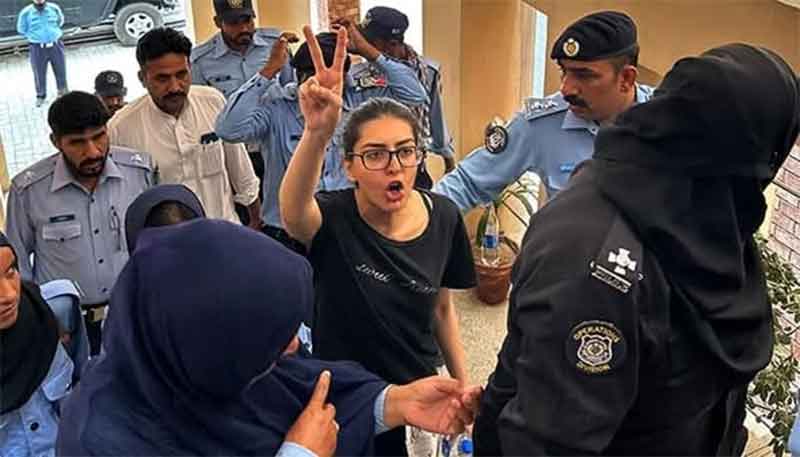
There are moments when a prison sentence ceases to be merely a punishment imposed upon an individual. It becomes a statement about the kind of society a state wishes to create.
The imprisonment of human-rights lawyers Imaan Zainab Mazari-Hazir and her husband, Hadi Ali Chattha, is one such moment.
On January 24, 2026, an Islamabad sessions court sentenced each of them to an aggregate 17 years in prison and imposed a Rs36 million fine on each under Sections 9, 10 and 26-A of Pakistan’s Prevention of Electronic Crimes Act. The prosecution alleged that their social-media activity glorified offences, amounted to cyberterrorism and spread false or fake information. (ecoi.net)
But beneath the language of cybercrime and national security lies a much older story.
It is the story of people who disappear.
It is the story of mothers who wait.
And it is the story of a lawyer who decided that the suffering of Baloch families was not someone else’s problem.
A lawyer who refused to look away
Imaan Mazari became known in Pakistan not simply as a lawyer, but as a human-rights advocate willing to enter some of the country’s most politically dangerous cases.
She represented victims of alleged enforced disappearances, extrajudicial killings and custodial abuse. International legal organisations describe her as a lawyer who repeatedly challenged state practices and defended people whose voices were otherwise easily ignored. (International Commission of Jurists)
That work brought her increasingly into the orbit of Balochistan.
For Baloch families, enforced disappearance is not a theoretical human-rights question.
It is an empty bed.
An unanswered telephone.
A photograph carried from one protest to another.
A mother growing old without knowing whether her son is alive.
A child growing up with a father’s photograph instead of a father’s hand.
For years, Baloch families have travelled from Balochistan to Islamabad carrying precisely those photographs.
They have sat on pavements.
They have held demonstrations.
They have organized sit-ins.
They have pleaded with institutions of the Pakistani state to tell them where their loved ones are.
And Imaan stood beside them.
That solidarity is central to understanding why her imprisonment has resonated so deeply among Baloch human-rights activists.
Her relationship with the Baloch movement was not merely something expressed through social media. She appeared in the physical spaces where Baloch students, families and activists brought their grievances to Islamabad.
When Baloch students protested over disappearances, she was there.
When the families of missing persons demanded answers, she was there.
When the Baloch Yakjehti Committee and its leaders came under state pressure, she continued to speak.
And when Dr. Mahrang Baloch became one of the most recognizable faces of the Baloch human-rights movement, Imaan publicly expressed solidarity.
According to Amnesty International, the social-media case against Imaan and Hadi included posts expressing solidarity with Baloch and Pashtun activists and criticism of Pakistan’s military. (Amnesty International)
The state saw dangerous speech.
Others saw conscience.
The crime of asking where the missing are
This is where the story becomes larger than Imaan Mazari and Hadi Chattha.
If a citizen says, Where is my disappeared son?, is that a threat to the state?
If a lawyer asks the government to produce a missing person before a court, is that cyberterrorism?
If a human-rights defender stands beside a peaceful demonstration demanding information about prisoners and missing persons, does solidarity itself become a crime?
These questions are not merely Pakistani questions.
They are universal questions about the relationship between state power and human dignity.
Five United Nations Special Rapporteurs expressed alarm following the convictions of Imaan and Hadi. They warned that freedom of expression should not be conflated with criminal conduct, particularly terrorism, and raised concerns that the broad application of terrorism-related provisions could criminalize the work of lawyers and human-rights defenders. (ecoi.net)
Their concern went further.
The UN experts raised questions about the fairness of the proceedings, including the time available to prepare a defence, access to chosen counsel and the taking of evidence in the absence of the accused. They also noted that the two lawyers had faced numerous criminal complaints since 2022 without previous convictions. (ecoi.net)
These observations deserve serious attention.
Because a democracy is not measured by how comfortably it treats those who praise the government.
It is measured by how it treats those who question it.
Balochistan’s long shadow
For decades, Balochistan has occupied a troubling place in Pakistan’s political history.
The province is rich in natural resources yet remains marked by poverty, political alienation, militarization and allegations of enforced disappearances and extrajudicial violence.
The Baloch question has survived generations of governments because it is not simply a question of one political party or one military operation.
It is a question of political legitimacy.
It is a question of whether a population believes that the state hears its grievances.
And above all, it is a question of whether the disappearance of a citizen can be treated as an administrative inconvenience rather than a profound human tragedy.
Imaan’s significance to Baloch activists therefore lies partly in the fact that she came from Islamabad’s legal world yet refused to remain insulated from Balochistan’s suffering.
She crossed a psychological boundary.
She told Baloch families, in effect:
Your grief is not invisible.
That is why her imprisonment carries a symbolism that reaches beyond her own case.
When the lawyer becomes the accused
There is a cruel irony in the imprisonment of Imaan and Hadi.
They are lawyers.
Their profession is built upon the proposition that every person accused by the state deserves representation.
They have spent their careers entering courtrooms where the accused are often powerless.
Now they themselves are prisoners.
The people who once walked into court carrying their clients’ files are now represented by lawyers carrying their files.
The courtroom has changed sides.
But the fundamental question remains the same:
Does the law exist to protect the citizen from arbitrary power, or can the law itself become an instrument of fear?
International legal organisations have described the couple’s prosecution as part of a pattern of harassment and have called for their convictions to be overturned. (International Commission of Jurists)
That does not mean that every statement made on social media is beyond the reach of law.
Freedom of expression has limits.
States have legitimate responsibilities to prevent incitement to violence and genuine threats to public safety.
But those legitimate responsibilities become dangerous when vaguely defined offences are stretched to encompass political criticism, human-rights advocacy or solidarity with marginalized communities.
The distinction is essential.
Without it, dissent can become terrorism simply because the state dislikes the message.
The woman behind the lawyer
Yet Imaan Mazari should not be reduced to a legal case.
There is also a woman behind the lawyer.
A woman who chose a difficult profession.
A woman who repeatedly walked into spaces where fear had already silenced many others.
A woman who stood beside Baloch families when doing so was politically uncomfortable.
And a woman whose husband chose to stand beside her.
Hadi Ali Chattha’s role matters too.
He did not merely watch from the sidelines. He became part of the same legal and human-rights struggle.
When Imaan spoke, Hadi stood with her.
When she faced prosecution, he faced it too.
And when the state turned its attention toward both of them, they entered the prison system together.
Their story is therefore also a story about companionship.
About a husband and wife sharing not only a profession but a conviction.
They may now be separated from the ordinary life they built together.
But there is something profoundly moving in the fact that neither abandoned the other when silence might have been easier.
What happens to a country when its lawyers become afraid?
The imprisonment of Imaan and Hadi should concern Pakistan far beyond the Baloch movement.
Because today the issue is Balochistan.
Tomorrow it may be Kashmir.
The day after, Khyber Pakhtunkhwa.
Then journalists.
Then students.
Then lawyers.
Eventually, a society may reach the point where everyone knows what cannot be said but nobody remembers when the prohibition began.
That is how freedom disappears.
Not always with tanks in the streets.
Sometimes it disappears quietly.
A journalist deletes a paragraph.
A lawyer refuses a case.
A student stops attending a protest.
A mother decides not to ask where her son went.
A citizen sees something wrong and chooses silence.
Fear becomes ordinary.
And once fear becomes ordinary, repression no longer needs to shout.
The question that will not disappear
Imaan Mazari’s imprisonment cannot erase the Baloch missing persons.
It cannot erase their photographs.
It cannot erase their mothers’ memories.
It cannot erase the years spent waiting.
And it cannot make the question disappear:
Where are the missing?
That question existed before Imaan spoke.
It will exist after her sentence.
It will survive every courtroom, every prison wall and every social-media ban.
Perhaps that is what those who prosecute human-rights defenders sometimes fail to understand.
A person can be imprisoned.
A newspaper can be censored.
A tweet can be deleted.
But a question born from human suffering is much harder to imprison.
A test for Pakistan
The case of Imaan Mazari and Hadi Chattha is therefore not simply a dispute over tweets.
It is a test of Pakistan’s relationship with dissent.
It is a test of whether lawyers can defend unpopular people without becoming targets themselves.
It is a test of whether Baloch families can seek justice without being portrayed as enemies.
It is a test of whether the state is confident enough to tolerate criticism.
And ultimately, it is a test of whether Pakistan understands the difference between protecting the state and protecting those who happen to control the state.
Five UN experts have already sounded the alarm. International human-rights organisations have condemned the convictions. The couple continues to challenge their sentences through the courts. (ecoi.net)
The world should listen.
Not because Imaan Mazari is above the law.
Not because Hadi Chattha is above the law.
But because the law itself must remain below the principles of justice and human dignity.
Imaan once stood beside the Baloch families who came to Islamabad carrying photographs of their disappeared loved ones.
Now she and her husband are behind bars.
But the photographs remain.
The mothers remain.
The unanswered questions remain.
And somewhere in Balochistan, another family is still waiting at a door that may never open.
Perhaps the most fitting tribute to Imaan Mazari and Hadi Chattha is therefore not to call them heroes.
It is simply to remember why they spoke.
They spoke because someone had to.
They stood because someone was disappearing.
They questioned because someone had stopped answering.
And they refused to accept that silence was the price of citizenship.
Seventeen years can imprison two people.
It cannot imprison the truth they were asking the state to confront.
It cannot imprison a mother’s memory.
It cannot imprison a lawyer’s conscience.
And it cannot make the disappeared disappear from history.
Baloch Siddik Azad is a Baloch writer, political commentator and human-rights advocate whose work focuses on Balochistan, South Asian politics, self-determination, enforced disappearances and the relationship between state power and human rights. Writing from a Baloch perspective, he combines historical analysis with political commentary and literary narrative, seeking to bring the voices and experiences of marginalized communities into international discourse.
His writings have addressed Balochistan’s political history, the Baloch missing-persons crisis, civil resistance and the broader questions of federalism, sovereignty and human dignity in South Asia.