
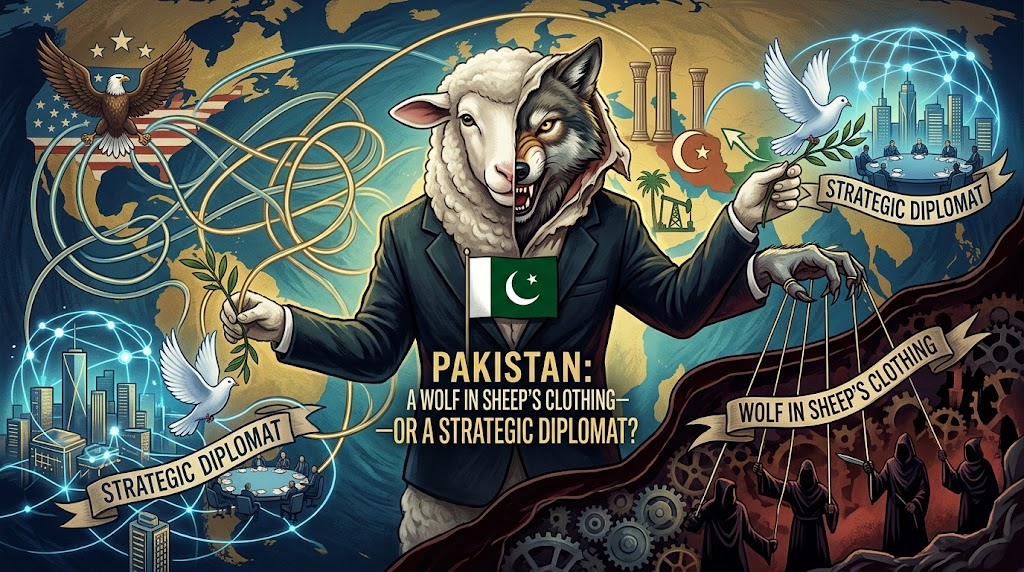
Pakistan Between Washington and Tehran: Strategic Diplomacy or Playing Both Sides?
Islamabad is trying to keep channels open with two adversaries while protecting its own interests. That balancing act is real—but the available evidence points to diplomacy and risk management, not proof that Pakistan’s government is secretly backing Iran.
Pakistan’s position in the U.S.–Iran conflict can look contradictory. Islamabad describes its relationship with Washington as a strategic partnership, maintains close ties with Tehran, and has worked to bring the two sides back to negotiations. At the same time, Pakistan has made a public commitment to Saudi Arabia’s defence as regional fighting has widened.
The question is whether this amounts to “playing both sides.” The public record suggests a more precise description: Pakistan is trying to preserve room to manoeuvre in a crisis that directly threatens its security and economy.
A mediator with interests of its own
Pakistan’s Foreign Ministry says Islamabad helped bring about the U.S.–Iran Memorandum of Understanding and continues to urge both governments to honour it and return to dialogue. In an October 16 briefing, the ministry also said Iran’s leadership had appreciated Pakistan’s mediation. Those are official Pakistani claims about its diplomatic role; they show what Islamabad says it is doing, though they do not establish that the agreement will hold or that the parties share Pakistan’s interpretation of it. (Pakistan Foreign Ministry, October 16; October 1 briefing)
There is evidence that the mediation has involved more than public statements. Pakistan’s Foreign Ministry announced that U.S. and Iranian representatives, alongside Pakistani and Qatari mediators, would take part in technical-level talks in Switzerland after the MOU was signed. The Associated Press also reported on an initial agreement between Washington and Tehran in June, while Reuters described Pakistani mediators working through competing drafts before a preliminary deal was reached. The reporting underlines both Islamabad’s access to the process and its limits: mediation can open a door, but it cannot make either side accept a lasting settlement. (Pakistan Foreign Ministry, June 20; AP, June 14; Reuters report)
Pakistan has also publicly reaffirmed its ties with the United States. Its Foreign Ministry calls the relationship a “strategic partnership” and says it wants to strengthen diplomatic, economic and security links with Washington. Maintaining contact with both capitals is not, by itself, evidence of duplicity. It is a familiar form of diplomacy for a state that would bear serious costs if the conflict spread across its borders. (Pakistan Foreign Ministry, October 1)
The Saudi commitment complicates the picture
Pakistan’s balancing act has a clear constraint: its relationship with Saudi Arabia. In late September, Defence Minister Khawaja Asif said Pakistan would stand by Saudi Arabia in the event of aggression, referring to the countries’ defence agreement. The Associated Press reported that Pakistan had offered one of its clearest indications yet that it could become involved in the widening regional conflict, while Pakistan’s military leadership has continued to describe the country as a broker seeking a peaceful outcome. (Radio Pakistan, September 26; AP, September 29; Radio Pakistan, October 9)
That commitment does not prove Pakistan has joined a campaign against Iran. But it does mean Islamabad’s assurances of neutrality have to be read alongside its defence obligations and public statements. If Saudi Arabia were attacked, Pakistan could face a choice that its mediation efforts cannot resolve through careful wording alone.
What the sanctions evidence does—and does not—show
There is a concrete reason the question of Iranian military support has surfaced. In September, the U.S. Treasury sanctioned individuals and entities based in Pakistan, Iran and Hong Kong, accusing them of helping procure weapons and components for Iran’s defence ministry. That is a significant U.S. government allegation about named actors and networks. It should be reported accurately, but it is not proof that Pakistan’s government directed or approved their activity. (U.S. Treasury, September 2026; AP coverage, September 29)
The distinction matters. A sanctions designation is an official accusation and a legal measure by the U.S. government; it is not, on its own, an independent public finding that the Pakistani state supplied Iran with military aid. The public evidence cited here does not establish secret state-sponsored military support. Claims of that kind require specific, independently verifiable evidence—not inference from Pakistan’s diplomatic contact with Tehran or from the nationality of a sanctioned person or company.
Why the balancing act is practical
Pakistan shares a long border with Iran, and developments along it have direct consequences for people and trade in Balochistan. In October, Pakistani authorities temporarily closed official crossings at Gabd-Rimdan and Taftan, with a provincial government adviser citing security concerns, smuggling and efforts to improve border management. A closure can disrupt livelihoods and legal commerce even as officials present it as a security measure. (Dawn, October 18)
Pakistan therefore has reason to prevent a wider war, preserve cross-border stability, and avoid alienating either Washington or Tehran. Those interests help explain why it seeks a mediator’s role while maintaining relationships on both sides. They also make the policy fragile: a regional escalation, an attack on Saudi Arabia, or a border incident could force Islamabad to choose between competing commitments.
Verdict: balancing is clear; “playing both sides” is not proven
Pakistan is pursuing overlapping interests: mediation with Iran and the United States, continued ties with Washington, a security commitment to Saudi Arabia, and stability along its own borders. Critics can reasonably ask whether these goals are compatible, and whether Islamabad can remain an effective broker while making defence pledges elsewhere.
But “playing both sides” implies more than having relationships with rival states. It suggests deliberate duplicity or covert assistance. The public record reviewed here supports a case for strategic hedging and diplomacy under pressure. It includes a U.S. accusation against Pakistan-based procurement actors, but does not establish that Pakistan’s government secretly supplied Iran’s military.
For readers in Pakistan and Balochistan, the stakes are concrete. If Islamabad’s diplomacy helps contain the conflict, border communities and regional trade may benefit. If the balancing act fails, those communities may feel the consequences long before the governments involved reach any final agreement.