
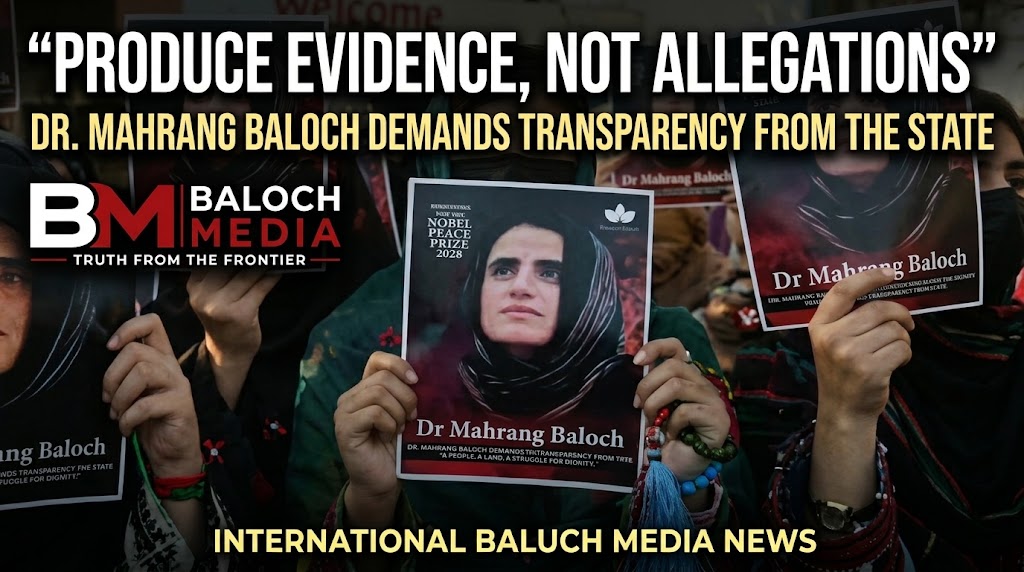
Produce Evidence, Not Allegations: Dr. Mahrang Baloch Demands Transparency from the State
If the government possesses evidence, it should present it before the 260 million people—why rely solely on accusations? Dr. Mahrang Baloch poses a direct question: since when has demanding one’s rights become treason?
Addressing the allegations leveled against her, Dr. Mahrang Baloch asked: if the government and state institutions truly possess evidence that she is working for another agency or receiving funding from abroad, why has this evidence not been presented to the public? How long will individuals continue to be subjected to such grave accusations, and when will the evidence forming the basis of these claims finally be brought to light?
She stated that if there are allegations regarding foreign funding, working for another country, or maintaining ties with foreign entities, then a formal investigation should be conducted. Her financial affairs, bank accounts, transactions, assets, and other relevant records should be examined. If evidence of any illegal activity exists, it should be presented in accordance with the law. However, if someone’s reputation is being damaged based merely on accusations, the question inevitably arises: what is the truth behind these claims, and where is the concrete evidence to support them?
Dr. Mahrang Baloch’s fundamental question is this: given that the state possesses investigative agencies, access to relevant records, and the authority to conduct inquiries, why does it resort to mere accusations instead of presenting evidence?
“I do not live in another country; I live in Pakistan. On this very soil, I speak of my rights; I articulate the grievances of the people of this country; and I strive to be a voice for those families living within this society who, for years, have endured immense hardship—struggling with the disappearance of their loved ones, the pursuit of justice, and the quest for their fundamental rights.”
If anyone disagrees with my stance, let that disagreement be addressed through reasoned argument. If there is a legitimate legal complaint or a matter warranting investigation against me, let it be handled in accordance with the law. However, disagreement with an individual’s demands should never serve as the basis for a grave accusation, such as treason.
After all, is demanding one’s rights an act of treason? Is voicing the problems of one’s own people treason? Is raising questions on behalf of the families of the disappeared—treason? Does seeking answers from the government automatically constitute proof of being part of a foreign agenda?
These are questions that demand serious consideration. In any nation, citizens must possess the right to articulate their grievances, demand their legal rights, and question the actions of the government. Instead of transforming dissent into hostility, there should be a robust tradition of listening to differing opinions and responding to them. If a citizen truly faces a serious charge, there are established legal procedures, avenues for investigation, and a judicial system to address such matters. Why, then, is it not considered necessary to clarify the basis of such accusations—and the evidence supporting them—before publicly labeling an individual a “traitor”?
Furthermore, given that it is legally possible to examine an individual’s financial affairs, bank records, property holdings, and other relevant data, why are transparent investigations not conducted to ascertain the truth behind allegations of foreign funding? If any illegal transaction or foreign financial support is proven, the relevant evidence should be brought forward; conversely, if no such evidence exists, one should refrain from damaging an individual’s reputation based merely on speculation or baseless claims.
Pakistan does not belong to any single individual, political party, or institution; it is the country of all its citizens. Every citizen living in this nation has the right to raise questions regarding their future, the conditions in their region, the challenges faced by their families, and their fundamental rights. While one may disagree with a citizen’s stance, challenge their arguments, or scrutinize their claims, any serious allegation must be supported by evidence and a legal basis.
It is also essential to listen to the concerns raised by individuals in various parts of Balochistan regarding human rights, the hardships faced by the families of missing persons, and issues concerning education, healthcare, employment, and justice. If there are flaws in their demands, these should be addressed through reasoned argument and facts. If there is evidence that someone has broken the law, then action should be taken in accordance with the law. However, labeling every dissenting individual a “traitor” neither resolves the underlying issues nor silences the questions raised by the public.
The core question is not who is accusing whom, but rather: what is the basis for these accusations?
If evidence exists, it should be presented through proper legal channels; investigations must be transparent, the accused must be given the opportunity to present their side, and the matter should be resolved according to the law. An accusation against a citizen cannot be accepted as fact simply because it is leveled by a powerful institution or the government. Likewise, a citizen’s own account cannot be declared an absolute truth without a thorough investigation. The demands of justice dictate that every claim be evaluated based on evidence.
The questions raised by Dr. Mahrang Baloch give rise to a broader discussion: Is a tradition taking root in our society—one that fosters tolerance for dissenting opinions, encourages listening to the concerns of citizens, and requires that serious allegations be substantiated with evidence? Or are we still spending our time leveling accusations against one another instead of addressing the issues at hand?
Whether it concerns the government or any other state institution, accountability to the public, transparency, and the rule of law are essential principles for all. If an allegation is valid, evidence should be presented to substantiate it; and if an individual’s allegations are not proven, one should refrain from labeling an individual a criminal or a traitor based merely on suspicion.
Listening to those who demand their rights, addressing their questions, and substantiating any serious accusation with evidence—this is the very foundation of a just society.
Now, a question lies before the 260 million people of Pakistan: If a citizen is accused of receiving foreign funding or working for another country, shouldn’t concrete evidence be presented to support such a claim? Is it not essential to have a legal basis and credible proof before declaring someone a traitor? Furthermore, is it not the responsibility of the government and relevant institutions to respond to the questions raised by citizens who speak up for their rights, justice, and fundamental freedoms?
What is your opinion? Should grave accusations—such as treason—be leveled based solely on statements, or is it necessary to substantiate them with evidence and in accordance with the law? Please share your thoughts in the comments.
�� International Baluch Media News — Our voice for public issues, rights, and significant news.
#BalochMediaNews #InternationalBaluchMediaNews #DrMahrangBaloch #Balochistan #FundamentalRights #MissingPersons #Justice #FreedomOfExpression #RuleOfLaw #Pakistan