
By Mir Taar Baloch | Balochistan
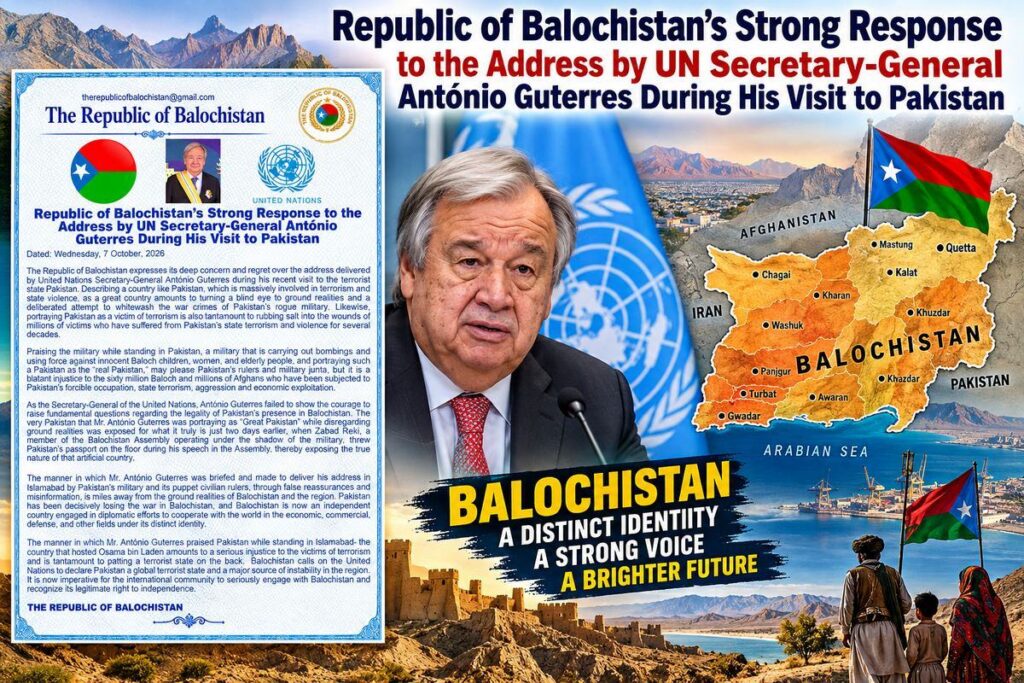
The Republic of Balochistan has expressed strong criticism of remarks attributed to United Nations Secretary-General António Guterres during his ongoing visit to Pakistan, arguing that the international community must pay greater attention to the situation in Balochistan and to allegations of human-rights violations in the region.
Guterres is visiting Pakistan from 6 to 8 October 2026 at the invitation of Pakistan’s Deputy Prime Minister and Foreign Minister Mohammad Ishaq Dar. His programme includes meetings with Pakistan’s political and military leadership, as well as visits to the United Nations Military Observer Group in India and Pakistan (UNMOGIP) and the National Disaster Management Authority. Ministry of Foreign Affairs Pakistan.
In a statement issued on Wednesday, the Republic of Balochistan said it was disappointed by what it described as an overly favourable portrayal of Pakistan and argued that such messaging failed to reflect what the organisation considers the realities on the ground in Balochistan.
Concern Over UN Narrative
The statement particularly objected to the characterisation of Pakistan as a victim of terrorism, saying that such a description, in its view, overlooks allegations of state violence and abuses faced by Baloch civilians over several decades.
The Republic of Balochistan further criticised what it described as praise for Pakistan’s military, alleging that security operations have affected civilians, including women, children and elderly people.
“These remarks, in our assessment, risk overlooking the experiences and grievances of Baloch communities,” the statement said.
The organisation called on the UN leadership to examine allegations concerning military operations, disappearances, civilian casualties and restrictions on political activity in Balochistan through an independent and transparent process.
Questions Over Balochistan’s Political Status
A central issue raised in the statement was the political and constitutional status of Balochistan.
The Republic of Balochistan argued that the United Nations should examine what it described as the unresolved question of Pakistan’s authority over Balochistan rather than relying exclusively on briefings provided by Pakistan’s government.
It also asserted that Balochistan should be treated as a distinct political entity and claimed that representatives associated with the Republic are seeking international engagement in areas including trade, economic development, security and diplomacy.
These claims represent the position of the Republic of Balochistan and remain politically contested.
Reference to Recent Balochistan Assembly Incident
The statement also referred to an incident involving Balochistan Assembly member Zabad Reki, whom it said had publicly discarded his Pakistani passport during an Assembly speech.
The Republic described the episode as evidence of growing political discontent and as an indication of the depth of opposition to Pakistan’s political system among sections of Baloch society.
Demand for Independent International Engagement
The organisation further questioned whether the UN Secretary-General had received sufficiently independent information about conditions in Balochistan before making his remarks in Islamabad.
It called for international observers, journalists and human-rights organisations to have greater access to affected areas so that allegations concerning security operations and civilian rights can be independently assessed.
The statement argued that diplomatic engagement should extend beyond Pakistan’s federal authorities and include representatives of Baloch political and civil-society groups.
Call for UN Action
The Republic of Balochistan called upon the United Nations to investigate allegations of terrorism, human-rights violations and military abuses attributed to Pakistani authorities.
It also urged the international community to engage directly with Baloch representatives and to consider what it described as Balochistan’s right to self-determination and independence.
The organisation went further by calling for Pakistan to be internationally designated as a state sponsor of terrorism—an assertion and political demand that are not established as a UN determination.
A Wider Diplomatic Question
The controversy comes during a high-level UN visit in which Pakistan has sought to highlight its cooperation with the United Nations, multilateralism, international peace and security, and disaster preparedness. Pakistan’s Foreign Office has said that Guterres’ visit provides an opportunity for discussions on regional and international developments and for highlighting Pakistan’s cooperation with the UN. Ministry of Foreign Affairs Pakistan
For Baloch political organisations critical of Islamabad, however, the visit represents an opportunity to press the UN to look beyond official government narratives and investigate allegations concerning Balochistan independently.
The Republic of Balochistan concluded its statement by urging the United Nations and the wider international community to give greater attention to the political aspirations, security concerns and human-rights allegations emerging from Balochistan.
— Mir Taar Baloch | Balochistan