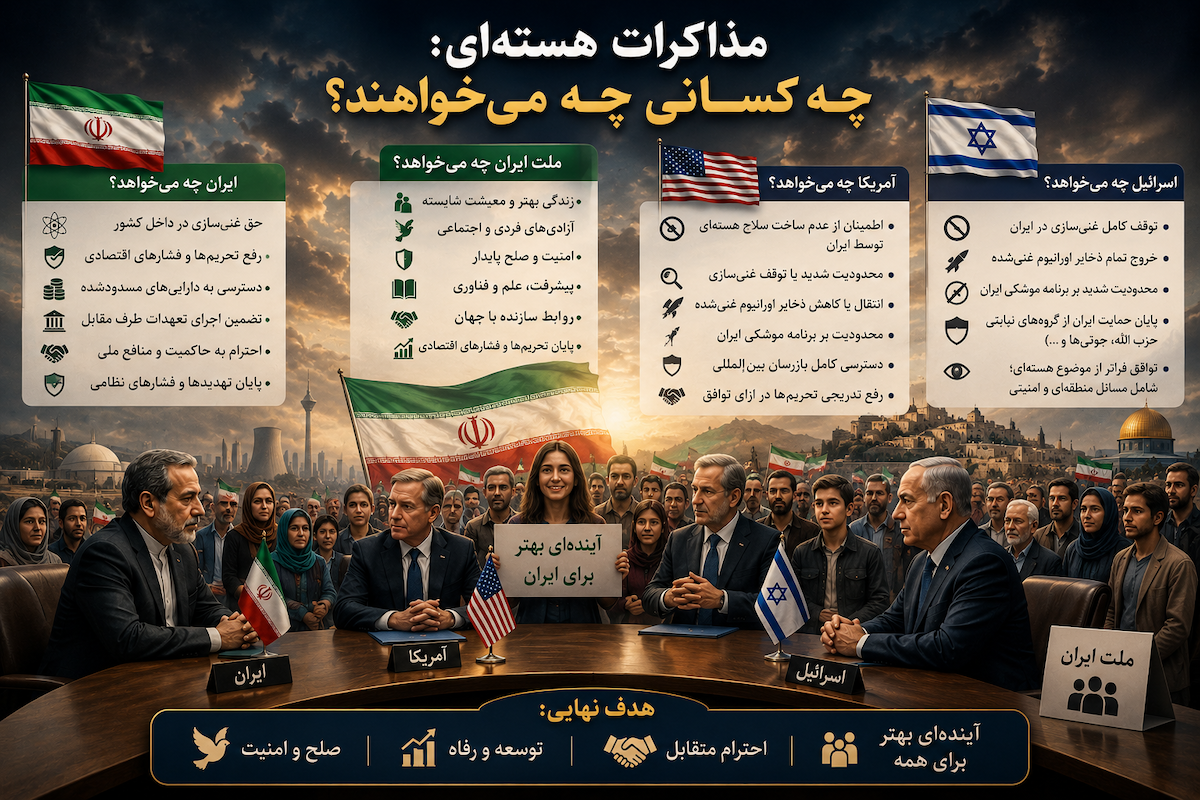
What exactly do Iran, the US and Israel want
To summarize the positions of the three parties in the simplest possible way, the main differences are that Iran wants to maintain the right to enrich uranium and lift sanctions, the US wants to ensure that Iran does not acquire nuclear weapons, and Israel wants restrictions beyond the nuclear issue.
What does Iran want?
🇮🇷 Iran has generally emphasized the following:
Recognition of the right to enrich uranium domestically.
Lifting or easing economic sanctions.
Release of frozen Iranian assets.
Receiving guarantees that the other party will adhere to the agreement.
In some recent positions, an end to conflicts on regional fronts, including Lebanon, and a reduction in military pressure.
What does the US want?
🇺🇸 The US’s stated goal is to prevent Iran from acquiring the ability to build nuclear weapons. In various reports, the US demands have included the following:
Closing or severely limiting uranium enrichment.
Transferring or reducing enriched uranium stocks.
Broad access for International Atomic Energy Agency inspectors.
Restrictions on some parts of Iran’s missile program.
Some reported proposals have called for dismantling or disabling key nuclear facilities.
In contrast, the US has spoken of a gradual lifting of sanctions and providing economic incentives.
What does Israel want?
🇮🇱 Israel usually takes a tougher stance than the US and believes that the agreement should not be limited to the nuclear issue alone.
The demands put forward by Israeli officials include:
The withdrawal or transfer of all of Iran’s enriched uranium stocks.
A complete halt to enrichment on Iranian soil.
Severe restrictions on its ballistic missile program.
Ending Iran’s support for regional allies such as Hezbollah and the Houthis.
Israel has repeatedly argued that an agreement that focuses solely on the nuclear program is not enough for it.
Where is the real problem?
The biggest obstacle currently seems to be the issue of uranium enrichment:
Iran says “enrichment is our right.”
The US, in some positions, wants “zero enrichment” or very broad restrictions.
Israel also wants a complete halt to enrichment and the transfer of uranium stocks.
For this reason, even if progress is made on some economic or security issues, the disagreement over enrichment remains the most important factor slowing or impeding the negotiations.
As of today (June 2, 2026), the state of the Iran-US talks can be described as “progress with ambiguity”; neither a final agreement has been reached nor have the negotiations completely stopped.
The most important recent developments:
Numerous reports indicate that the two sides are close to a preliminary understanding or memorandum of understanding aimed at consolidating the ceasefire, reducing tensions and creating a framework for broader negotiations. However, final details have not yet been finalized.
According to some reports, the main differences remain over Iran’s nuclear program, enriched uranium stocks, inspection mechanisms, missile program and the way sanctions are lifted.
In recent days, news sources have reported the possibility of holding a new round of talks in early June.
At the same time, American and Iranian officials have sent mixed signals; on the one hand, progress has been reported in the talks, on the other, it has been emphasized that there are still significant differences.
In a nutshell: the talks are not completely deadlocked, but they are still far from a stage where they can be considered a final and lasting agreement. The parties have apparently managed to reach preliminary frameworks on some issues, but the sensitive nuclear and sanctions issues remain the main obstacles.