
Will Balochistan become a strategic weak point that drains the Iranian state’s resources or will the authorities manage to contain the crisis by addressing its political and social roots?
Yousef Azizi
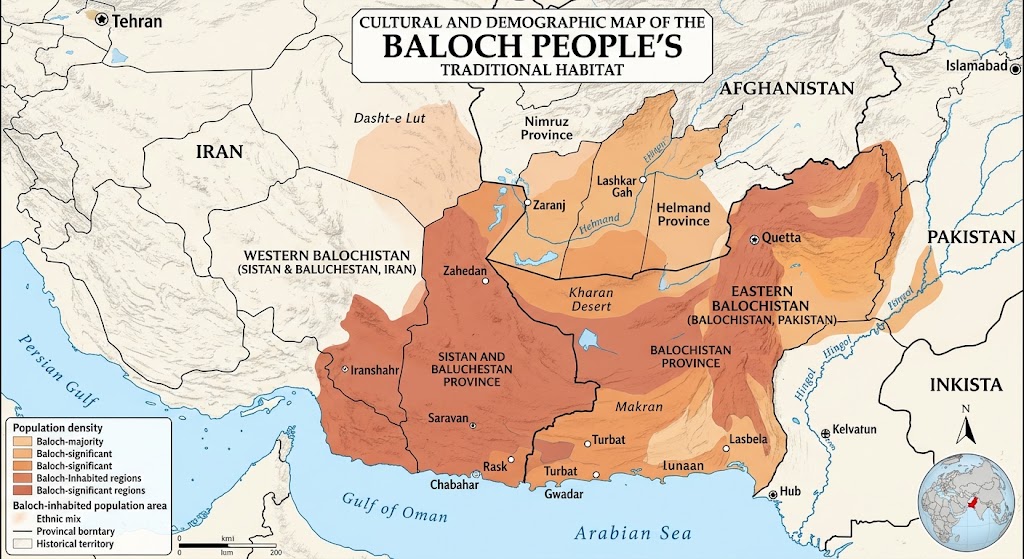
Balochistan Province lies in Iran’s far southeast and is the country’s second-largest province by area, after Kerman. It consists of two main regions: Sistan, whose population is predominantly Shia (Zabul City), and Balochistan with capital Zahedan, which is accounts for most of the province’s territory, and has a predominantly Baluch area in Khurasan, Kerman, Hurmuzgan from Bandar Abas to border of eastern Balochistan, Pakistan, Baluchi speaking and Sunni population.
If we classify the regions inhabited by Iran’s non-Persian national and ethnic communities according to their national identities and geographical characteristics, rather than the country’s official administrative divisions, we can speak of Balochistan as a distinct region within Iran. This region extends beyond the Baloch-inhabited areas of Sistan and Balochistan Province to include parts of Kerman Province, Hormozgan, Khurasan Provincesv where Baloch communities also live.

Balochistan and the Islamic Republic: Marginalisation and the persecution of activists
Unlike people in some other parts of Iran, most Baloch people did not participate in the Islamic Revolution led by Ayatollah Khomeini in 1979. This may have stemmed from their fear that a religious authority with a particular sectarian orientation would come to power without guaranteeing the rights of Sunni Muslims, a concern that, in the eyes of many, subsequent developments appeared to confirm.
A significant part of the Baloch struggle has taken the form of peaceful civil and cultural activism. Yet the Iranian authorities have shown little tolerance for such activities either, imprisoning and executing a number of activists. Among them the most prominent was Yaqub Mehrnahad, a journalist and blogger who was executed at Zahedan Prison on August 4, 2008.
Mehrnahad was just 28 years old. According to the account on which this article draws, he was not known to have engaged in violence. Rather, he was a social and civil activist who headed the Zahedan bureau of Mardom-Salari, a newspaper published in Tehran.
His case recalls the executions carried out by the Iranian authorities in Ahwaz in 2014, when two Arab activists, Hashem Shaabani, a poet, and Hadi Rashedi, a cultural activist, were put to death. Both men had worked as secondary-school teachers in the Ahwazi city of Khalafabad. Neither was known to have resorted to violence; their activities were instead associated with the establishment of an independent cultural organisation called Al-Hiwar (“Dialogue”).
In my view, these two cases reveal a pattern in the security authorities’ treatment of independent civil and cultural activism among Arabs and Baloch. This pattern involves the use of the harshest punishments to deter activists and weaken social and cultural initiatives operating beyond the state’s control. Yet events did not necessarily unfold as the authorities intended. In Balochistan, armed groups subsequently emerged, among the most prominent of which was Jundallah, led by Abdolmalek Rigi.
From civil activism to armed struggle: The Experience of Jundallah
Abdolmalek Rigi led Jundallah, also known as the People’s Resistance Movement of Iran. The group concentrated its armed operations in the Balochistan region and presented itself as a defender of the rights of Baloch people and Sunni Muslims in Iran.
Between 2003 and 2011, the group carried out a series of armed operations, including attacks, bombings and hostage-taking. Its targets included military and security forces and police in the province and elsewhere in eastern Iran. These operations caused casualties among government forces and security personnel and also claimed the lives of several tribal leaders.
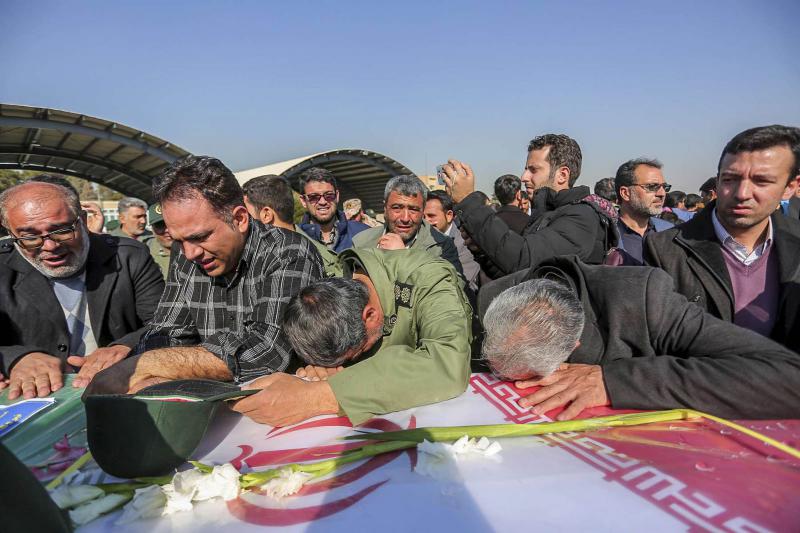
One of the most significant attacks took place on October 18, 2009, killing dozens of people, including senior commanders of Iran’s Islamic Revolutionary Guard Corps (IRGC). Among those killed were General Nour Ali Shoushtari, deputy commander of the IRGC’s ground forces, and General Rajab Ali Mohammad-Zadeh, who commanded the IRGC in Sistan and Balochistan Province, along with other military commanders and tribal leaders.
On February 23, 2010, Iranian authorities arrested Abdolmalek Rigi after intercepting the aircraft carrying him during a flight from Dubai to Kyrgyzstan, according to the widely reported account of his capture. He was hanged on 20 June 2010 at Evin Prison in Tehran.
Rigi’s execution, however, did not bring armed activity in Balochistan to an end. Other organisations subsequently emerged and continued to target government forces amid persistent security and political tensions in the region.
Jaish al-Adl and the escalation of armed confrontation
Jaish al-Adl, an Iranian Baloch opposition group that advocates armed struggle, emerged after Abdolmalek Rigi’s execution in June 2010, amid the decline of Jundallah and the rise of new armed formations. The group says it seeks to secure the rights of the Baloch people and Sunni Muslims and to confront the Islamic Republic.
Jaish al-Adl is regarded as one of the most prominent armed organisations operating in Iran, particularly in the Balochistan region. Its attacks have targeted police stations, IRGC facilities and border-guard positions, employing a range of tactics, including small arms, bombings and assaults on security installations. Its activities are also linked to a complex border environment in which security challenges intersect with smuggling routes across the borders with Pakistan and Afghanistan.
The organisation is led by Salah al-Din Farooqui. There are no reliable, independent statistics establishing its actual size. Media estimates vary, with some putting its strength at between 1,000 and 2,000 armed fighters.
In recent years, armed attacks have continued in Balochistan, claiming the lives of government personnel, while security crackdowns and death sentences have also targeted Baloch citizens and activists. Reports on the region point to a continuing cycle of violence: the authorities respond to armed attacks with intensified security operations, while armed groups continue to target state institutions.
Despite the restrictions imposed by the Iranian authorities on media coverage of security incidents, state media occasionally publish figures on losses sustained by government forces. Given the scarcity of independent information and the conflicting figures, it is difficult to establish the overall death toll accurately or to distinguish casualties of armed clashes from those resulting from other security operations. Nevertheless, the number of victims is estimated to run into the hundreds, most of them members of government forces.
The Popular Fighters’ Front and the widening conflict
In 2025, a newly-established armed coalition known as the Popular Fighters’ Front announced its emergence in Sistan and Balochistan Province. According to reports about its formation, the coalition brings together several groups, including Jaish al-Adl; the Pada Baloch Movement, founded in 2017; the Baloch Nasr Movement, established in 2006; the Muhammad Rasul Allah organisation; and independent Baloch fighters.
The front says it does not seek Balochistan’s secession from Iran, but rather the establishment of a federal system in the country. However, any assessment of the coalition’s nature, the degree of actual coordination among its constituent groups and its ability to unify armed operations depends on the availability of reliable, independent information about its activities and organisational structure.
Greater coordination among armed groups could intensify security pressures on the Iranian authorities in Balochistan, particularly if these groups succeed in coordinating their operations and exploiting the region’s geographical features and borderland terrain. Conversely, an escalation of the conflict could lead to tighter security measures, further aggravating the suffering of civilians and deepening tensions between local communities and the authorities.
The Baloch question, therefore, can no longer be reduced to religious, cultural or economic demands alone. It now encompasses questions of citizenship, equality and political representation, alongside security challenges and armed activity. This brings us to the central question posed by this article: Will Balochistan become a strategic weak point that drains the Iranian state’s resources or will the authorities manage to contain the crisis by addressing its political and social roots rather than relying solely on a security-based approach?
Popular support and allegations of foreign interference
Despite Iranian media claims that local residents reject Jaish al-Adl and demand its elimination, the organisation continues to launch attacks from time to time against Iranian military and security targets in Balochistan. According to some reports, the frequency of these attacks has increased, with incidents occurring almost daily during certain periods.
Some observers argue that the ability of the group’s members to move around and seek refuge in the region cannot be understood in isolation from the local social environment. They believe that the organisation could not have sustained its activities without a degree of sympathy or acceptance among some sections of the population. However, the extent of this popular support remains a question requiring independent evidence. It would be wrong to assume that all local residents share the same position on the organisation or its armed methods.
Iran accuses the United States, Britain and Israel of supporting armed movements operating in Balochistan, but these countries deny the allegations. Washington, meanwhile, designates Jaish al-Adl as a terrorist organisation, a fact that at least cautions against making broad claims about the existence of declared American support for the group.
Peaceful mobilisation: The Makki Mosque and the voice of Sunni muslims
The conflict between the Baloch people and the central authorities in Tehran is not confined to armed activity. It also encompasses peaceful political and religious mobilisation, whose most prominent expressions include Friday prayers in Zahedan, the region’s largest city and principal urban centre, as well as in other towns. These religious gatherings have become platforms for expressing social and political grievances and demanding rights.
Friday prayers in Zahedan assumed particular significance during the Woman, Life, Freedom uprising, which swept across large parts of Iran following the death of the young Kurdish woman Mahsa Amini in September 2022, after she had been detained by the morality police. In this context, Zahedan witnessed mass protests following allegations that an Iranian police officer had raped a Baloch girl in the city of Chabahar.
On September 30, 2022, security forces opened fire on demonstrators in Zahedan following Friday prayers. The events subsequently became known as Bloody Friday. Estimates of the death toll differed between official accounts and Baloch human rights and political sources: the authorities reported 35 deaths, while other estimates put the figure at more than 100. The events left a profound mark on the political consciousness of broad sections of the Baloch population.
Protests continued in Zahedan and other cities across the region for many months, even after demonstrations had begun to lose momentum elsewhere in Iran. During this period, the Makki Mosque and its Friday prayer leader, Mawlawi Abdolhamid Esmaeilzehi, emerged as symbols of open opposition to the policies of the Iranian authorities. His Friday sermons were no longer confined to religious matters but increasingly addressed fundamental freedoms, sectarian discrimination and political and social rights. Abdolhamid also extended his criticism to the marginalisation and violations of national rights experienced by Iran’s non-Persian peoples, including the Arabs of Ahwaz.
Over time, Mawlawi Abdolhamid acquired a standing that extended beyond Baloch society. He became one of the most prominent religious voices criticising the authorities among Iran’s Sunni Muslims, and his statements attracted growing attention in opposition political discourse.
Some analysts argue that the Baloch movement has received less solidarity from other parts of Iran than might have been expected. They attribute this, among other factors, to limited sympathy for Sunni demands among certain sections of the Shia population, as well as fears among some Iranians that national demands could lead to the fragmentation of the state. These explanations, however, remain political interpretations and cannot be generalised to Iranian society as a whole.
The roots of the Baloch question: Three interconnected factors
The Baloch question forms part of a broader issue concerning the rights of Iran’s non-Persian national groups, raising fundamental questions about equality, political participation and linguistic and cultural rights. Balochistan, however, has distinctive historical, social and geographical characteristics that set it apart from other regions. Three principal factors are particularly relevant in this context.
1. Economic marginalisation and underdevelopment
Although difficult economic conditions affect broad sections of Iranian society, Balochistan suffers from high levels of poverty and deprivation, inadequate industrial infrastructure and limited employment and investment opportunities. The roots of these problems stretch back several decades, including the era of the Shah, and subsequent policies have failed to eliminate them.
Sistan and Balochistan Province continues to rank among Iran’s most deprived provinces according to various indicators of development and well-being. The effects of this marginalisation extend beyond living conditions. They can also deepen perceptions of inequality and reinforce the belief among sections of the population that they are not receiving a fair share of the country’s resources and opportunities.
2. Sunni religious identity
Most Baloch people in Iran adhere to Sunni Islam, predominantly the Hanafi school. According to human rights reports and criticism voiced by religious and political figures, they have faced forms of sectarian discrimination and restrictions on participation in state institutions since the establishment of the Islamic Republic in 1979.
The Baloch also experienced national marginalisation under the Pahlavi monarchy. However, their position in Iranian nationalist discourse differed in certain respects from that of the Arabs. Some strands of Persian nationalist literature incorporated the Baloch into narratives concerning Aryan origins, whereas Arabs were portrayed as a Semitic, non-Aryan people. Such classifications were used in certain nationalist discourses to rank peoples according to hierarchical racial and cultural conceptions.
In my view, the differences in the experiences of Iran’s various national groups cannot be understood without examining the influence of these conceptions on cultural and linguistic policies and on the treatment of non-Persian identities.
3. Geopolitics and cross-Border connections
The Baloch population extends beyond Iran’s borders into parts of Pakistan and Afghanistan, giving the Baloch question a regional dimension. In some cases, the geographical character of the borderlands has provided armed groups with opportunities to move across borders and establish cross-border communication and supply networks. It has also made controlling the region a persistent security challenge for the Iranian authorities.
The issue is not limited to armed activity. Pakistan’s Balochistan province has also witnessed nationalist and political movements demanding greater rights, alongside separatist and armed groups operating in parts of the province. Consequently, the Baloch question in Iran is intertwined with the complexities of Pakistan’s domestic politics and with relations between the two countries.
This regional dimension became particularly apparent in January 2024, when tensions between Iran and Pakistan escalated following reciprocal attacks that Tehran and Islamabad said had targeted armed groups operating across their shared border. Iran’s Islamic Revolutionary Guard Corps struck locations inside Pakistan’s Balochistan province, claiming to have targeted sites associated with Jaish al-Adl. Pakistan responded with strikes inside Iranian territory, which it said targeted locations belonging to Baloch armed groups, including elements associated with the Balochistan Liberation Organisation.
Reuters quoted a Pakistani intelligence official as saying that the Pakistani strikes had targeted sites belonging to the Balochistan Liberation Organisation, an armed separatist movement operating in Pakistan’s Balochistan province. The two countries moved quickly to contain the crisis and restore diplomatic relations, but the incident exposed how readily local tensions can escalate into a regional crisis.
Thus, cross-border geography does more than provide armed groups with room to manoeuvre. It also exposes Iranian-Pakistani relations to recurring challenges, particularly when the two sides accuse each other of failing to prevent armed groups from using their territory or of violating national sovereignty under the pretext of pursuing such groups.
Attempts to alter ethnic composition
Iranian governments typically cloak their plans to alter the demographic composition of the Baloch and Arab populations in the language of economic and development projects. According to activists from both communities, however, this approach is not confined to state policy. It also intersects with proposals advanced in some circles of the far-right Persian nationalist opposition, whose figures have openly expressed support for redistributing the population towards Iran’s southern regions.
In October 2024, Hojjat Kalashi, a leading figure in the monarchist nationalist movement, called for the relocation of millions of people from Iran’s northern and central regions to the south, invoking arguments related to economic development. The proposed destination would include Ahwaz, where Arabs form the majority, and Balochistan, where Baloch constitute the majority. Critics argue that implementing a population redistribution scheme on this scale could not be separated from questions concerning the rights of the indigenous populations, their participation in decisions affecting the future of their regions, and the ethnic and social consequences of such transformations.
These suspicions were reinforced in the summer of 2025, when Iranian President Masoud Pezeshkian spoke of a plan to relocate the capital from Tehran and redirect development, industry and population centres towards Iran’s southern coast, stretching along the Arabian Gulf and the Sea of Oman. He described the move as “a strategic necessity, not an option”, citing the severe environmental crises confronting the Iranian central plateau.
Pezeshkian argues that internal migration in Iran is moving in the wrong direction, with people flocking to the capital and major cities such as Tehran, Karaj, Isfahan and Shiraz because wealth, infrastructure, services and administrative institutions are concentrated there. In his view, these cities have reached critical limits in terms of urban expansion and development capacity, while the housing crisis continues to worsen. He therefore proposes reversing or redirecting migration trends by establishing new economic centres in the south.
Baloch and Arab activists, however, whose peoples inhabit extensive parts of southern Iran, view these proposals with suspicion. They fear that the language of development may conceal strategic plans by the Persian-dominated centre to relocate millions of Persians to Ahwaz and Balochistan, potentially altering the social fabric and demographic composition of both regions in favour of incoming populations.
What lies ahead for Balochistan?
Because the Baloch are predominantly Sunni Muslims, the Iranian regime does not appear to fear to the same degree that the religious discourse embraced by some armed factions in Balochistan might spread to other parts of the country. At the same time, it recognises that Balochistan has not become a second Kurdistan, despite the fact that sections of the populations of both regions share the Sunni faith.
In my assessment, this is attributable to two principal factors. The first is Balochistan’s relative geographical distance from Iran’s centres of political power. The second, and more important, is the difference between the political environment in which Kurdish movements emerged and the environment in which Baloch political and religious actors operate.
During the first decade of the Islamic Republic, parts of Iranian Kurdistan came under the influence of Kurdish nationalist, left-wing and secular parties and factions. The region also became a refuge for political parties and organisations of various nationalist, left-wing and secular persuasions that had fled repression by the authorities elsewhere in Iran. The interaction between local forces and opposition organisations arriving from outside the region created a broader political environment that extended beyond the Kurdish national framework alone, enabling the movement there to acquire a national dimension that transcended the region’s boundaries.
The Baloch movement, despite its capacity at certain stages to challenge the authorities and disrupt their security apparatus, has not yet developed into a movement capable on its own of threatening the Iranian regime’s structure at the national level. This situation could change if the Kurdish movement joined forces with it, or if favourable political and social conditions emerged, such as those witnessed in Iran during the Woman, Life, Freedom protests following Mahsa Amini’s death in 2022. It could also change if a political alternative emerged that enjoyed the support of broad sections of Iran’s national communities and political forces and was capable of uniting their demands within a common project for change.
The future of the Baloch movement, therefore, depends not only on the balance of forces within Balochistan itself, but also on its ability to engage with protest movements elsewhere in Iran. It also depends on whether opposition forces are prepared to offer a political framework that recognises the country’s ethnic and religious diversity and guarantees the rights of its different peoples, rather than reproducing state centralism and exclusionary policies in a new guise.